
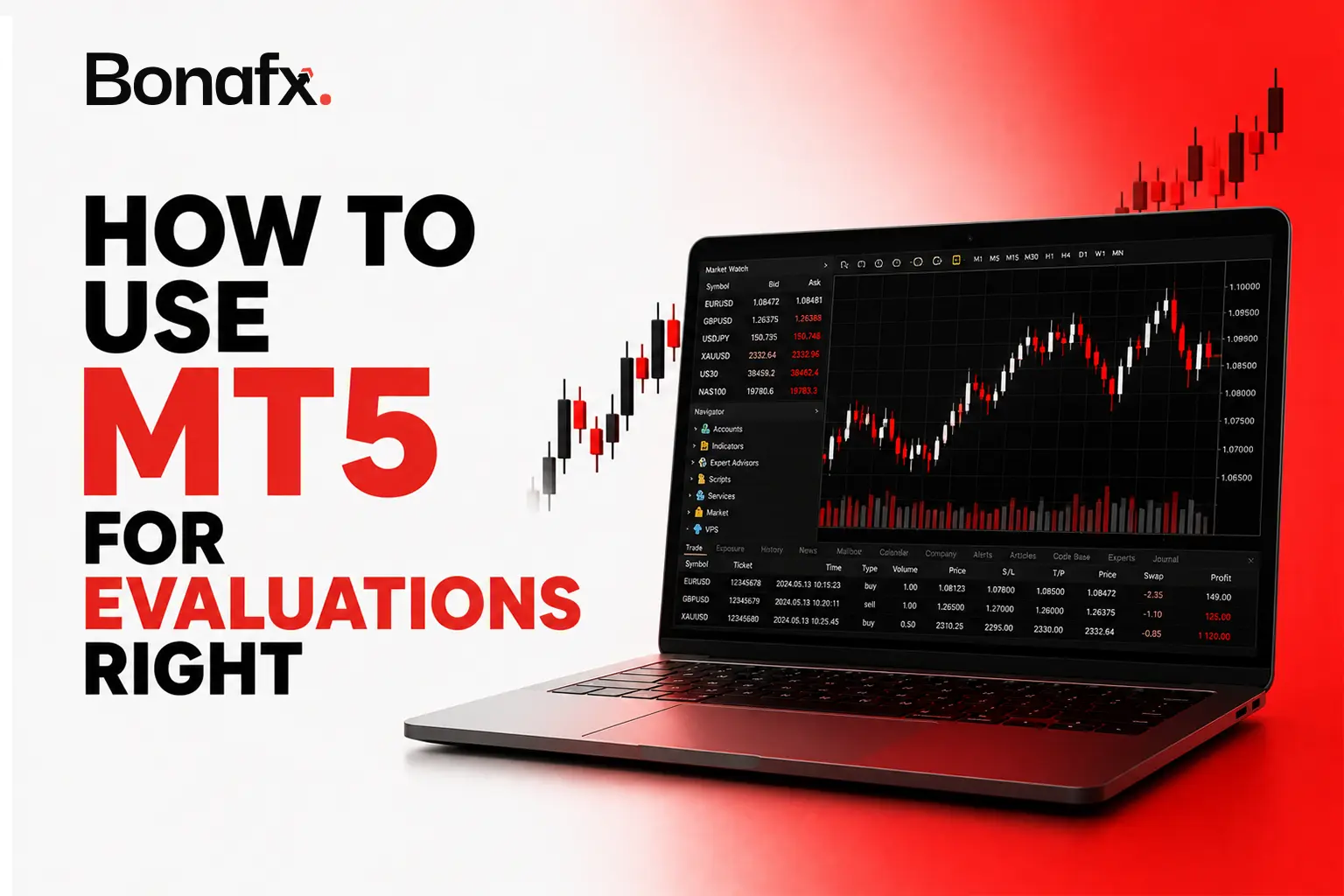
Most traders do not fail evaluations because they cannot read a chart. They fail because they use MT5 like a casual platform instead of a performance tool. If you want to know how to use MT5 for evaluations, start there. The platform is not just where you place trades. It is where you control risk, track compliance, and remove small execution mistakes that can cost you a funded account.
That matters even more in an evaluation environment. When your goal is to hit a profit target without violating drawdown rules, platform habits become part of your edge. A sloppy order entry, an oversized lot, or a missed stop adjustment can do more damage than a bad setup.
How to use MT5 for evaluations without wasting attempts
The first step is simple: set up MT5 to support disciplined trading, not impulsive trading. That means your watchlist should be tight, your chart layout should be clean, and your trade tickets should reflect the way you actually manage risk.
A lot of traders overload the platform on day one. They add too many symbols, too many indicators, and too many templates. That usually creates hesitation or noise. For evaluations, less is better. Keep only the markets you actively trade. Save one or two chart templates you trust. Make position sizing and stop placement as repeatable as possible.
MT5 gives you speed, but speed is only useful when your process is already clear. If your evaluation strategy depends on precise execution around key levels, use one-click trading carefully. If your strategy needs confirmation before entry, the standard order window may be safer. The right choice depends on your style, not on what feels faster.
Start with the evaluation rules, then build your MT5 workspace
Before you place a single trade, translate the evaluation rules into platform behavior. This is where many traders get caught. They understand the rules in theory but do not build them into their daily routine.
If your account has a maximum daily drawdown, your MT5 session should begin with one question: how much room do you actually have today? That should shape your lot size, the number of setups you take, and whether you scale into positions at all. If your challenge has an overall drawdown cap, you should monitor equity with the same focus you give price.
The Trade tab and Account History in MT5 are not just recordkeeping features. They are part of your control system. Get in the habit of checking floating loss, closed PnL, and margin before every new position. During an evaluation, one strong trade does not give you permission to get careless on the next one.
This is also where symbol specifications matter. Contract size, point value, and spread behavior can vary across instruments. If you trade forex, indices, metals, or crypto through MT5, make sure you know exactly how each product moves and how that movement affects your account. An instrument that looks familiar can still behave differently enough to throw off your normal risk model.
Set risk inside MT5 before you think about profit
The fastest way to sabotage an evaluation is to make profit target decisions before risk decisions. MT5 gives you the tools to avoid that, but only if you use them with intent.
Every trade should begin with a defined stop loss. Not a mental stop. Not a “I’ll manage it live” idea. A real stop entered into the platform. Evaluations reward discipline more than creativity. If you cannot define where the trade is wrong, you should not be in the trade.
Position size comes next. MT5 will let you place any size your margin allows. That does not mean the size fits your evaluation plan. Your lot size should reflect a fixed percentage or fixed dollar risk model, depending on how you trade. The key is consistency. If one loss costs 0.5% and the next costs 2.5% because you felt confident, you are no longer trading a system. You are gambling around a rule set.
Take profit orders are more flexible. Some traders perform better using fixed targets. Others manage exits manually based on structure or momentum. Both approaches can work in an evaluation, but each has trade-offs. Fixed targets reduce emotional interference. Manual exits can improve reward capture, but only if your execution stays disciplined under pressure.
Use MT5 tools that actually help evaluation performance
Not every feature in MT5 matters equally. For evaluations, a few tools carry most of the weight.
Chart templates help you standardize decision-making. If every chart looks different, your reads will drift. Save a layout that supports your strategy and use it across the instruments you trade.
The Depth of Market window can be useful for some traders, especially in fast-moving products, but it is not essential for everyone. If it improves timing, use it. If it distracts you, ignore it. Evaluations are about clean execution, not showing off platform knowledge.
Price alerts matter more than most traders think. Good alerts keep you patient. Instead of staring at the market and forcing trades, let MT5 notify you when price reaches your area of interest. That one habit can improve selectivity and reduce overtrading.
Account History is where the real work happens. After each session, review execution quality, not just PnL. Did you enter where planned? Did you respect the stop? Did you size correctly? MT5 gives you enough data to spot recurring mistakes quickly if you are honest about what you are looking at.
How to use MT5 for evaluations when conditions get fast
Fast markets expose weak habits. During news, breakouts, or high-volume sessions, MT5 can execute quickly, but your decision-making still needs structure.
First, know when not to trade. If your strategy does not include high-impact news conditions, do not improvise because volatility looks attractive. Evaluation accounts are lost every day by traders who abandon their process the moment the market starts moving hard.
Second, check slippage and spread behavior on the products you trade most. Raw pricing and strong execution conditions help, but there is still a difference between a calm session and a violent one. That means your stop placement and position size should account for real market conditions, not ideal ones.
Third, avoid revenge execution. MT5 makes it easy to re-enter quickly after a loss. That can be useful if your setup is still valid. It can also destroy your account if you are reacting emotionally. Speed is a platform feature. Discipline is your job.
Common MT5 mistakes that ruin evaluations
The most common mistake is placing trades before checking size. It sounds basic, but it happens constantly, especially when traders move between symbols with different volatility and contract values.
The second is treating floating drawdown like it does not count until the trade closes. In an evaluation, equity matters. A trade that is “still open” can still put you dangerously close to a breach.
The third is modifying stops in the wrong direction. Tightening risk to protect the account is one thing. Widening a stop because you do not want to take the loss is something else entirely. MT5 will let you do both. Only one belongs in a serious evaluation plan.
Another mistake is changing templates, indicators, or workflows mid-challenge. If your process was good enough to start the evaluation, it should be good enough to finish it. Adjustments are sometimes necessary, but random changes usually come from discomfort, not insight.
Build a repeatable MT5 routine
A strong evaluation run usually looks boring from the outside. That is a good sign. You want a repeatable routine that removes unnecessary decisions.
Before the session, check your account status, mark your levels, review your risk limits, and decide what conditions justify a trade. During the session, use MT5 to execute exactly what your plan allows. After the session, review fills, mistakes, and whether your behavior matched the rules.
That kind of routine creates stability, especially when there is no time limit and no reason to force results. A trader who respects the process usually lasts longer than a trader chasing a fast pass.
On a platform like MT5, professional execution is available to retail traders. The gap is not access. It is behavior. Firms like BonaFx build the evaluation path around clarity, execution quality, and trader-first rules, but the platform still rewards the traders who stay precise under pressure.
Use MT5 like your results depend on details, because they do. The traders who pass are not always the ones with the boldest entries. More often, they are the ones who make fewer avoidable mistakes and keep control long enough for their edge to show up.