
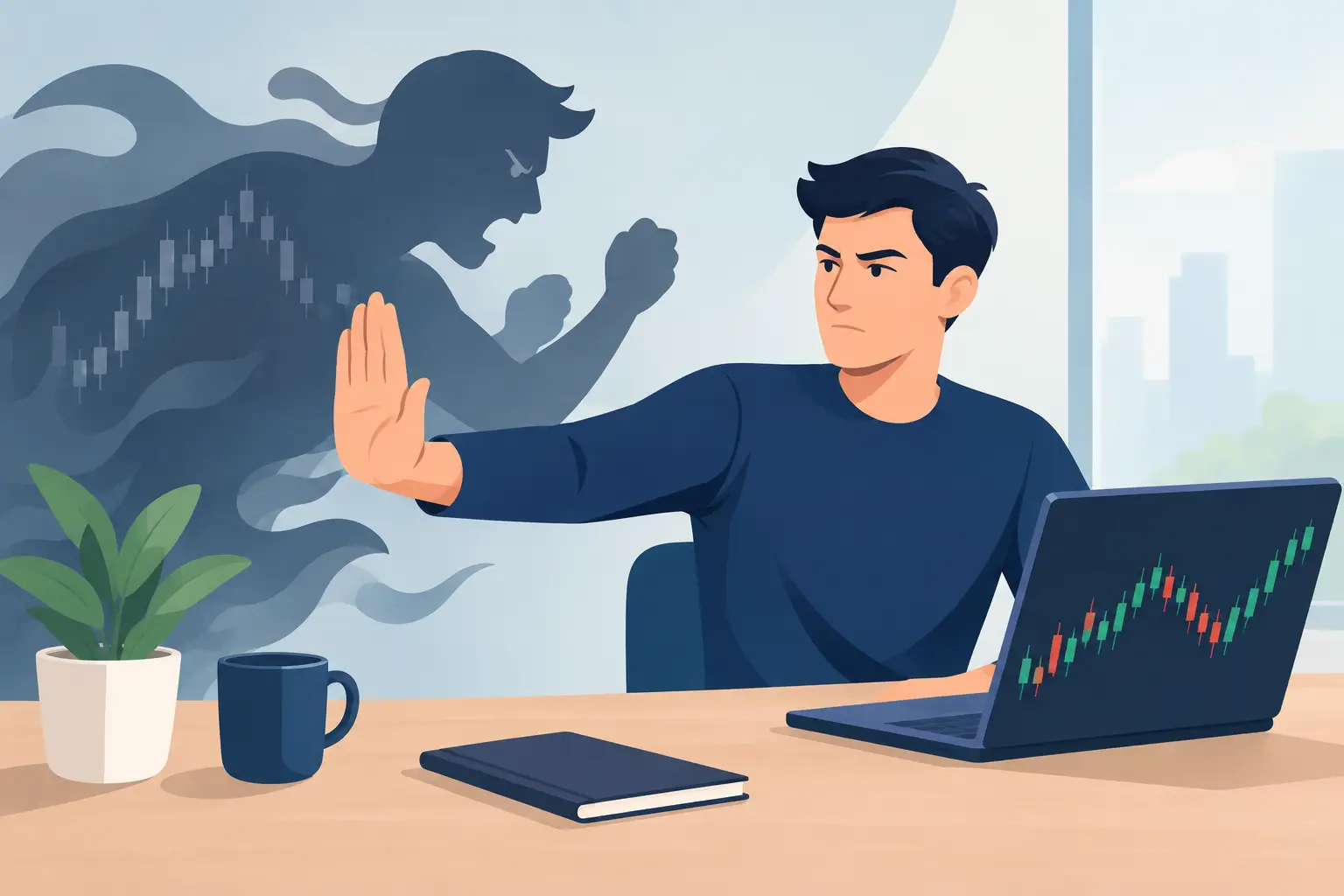
A losing trade is supposed to cost a planned amount. Revenge trading starts when you decide that planned amount is not acceptable and try to force the market to give it back. The result is rarely one bad decision. It is a chain reaction: larger size, weaker entries, ignored stops, and damage to an account that may have taken weeks to build.
For traders in a prop evaluation, that spiral has an even sharper edge. A daily drawdown limit does not care whether the first loss came from a valid setup or a bad fill. Once emotion takes over, the market is no longer the problem. Execution is.
Why Revenge Trading Hits Good Traders Too
Revenge trading is not a lack of market knowledge. Many traders who understand structure, liquidity, risk-reward, and news volatility still fall into it. The trigger is usually emotional pressure after a loss, a missed trade, or a day that started well and suddenly turned negative.
A trader sees a stop loss get hit and immediately looks for another position. But the new trade is not based on a clean setup. It is based on a need to erase discomfort. That difference matters. A valid trade has a defined thesis, invalidation level, position size, and reason for being taken now. A revenge trade has urgency.
The danger is that urgency can look like conviction. You may tell yourself that price is “obviously” going back, that you know the session will reverse, or that one larger win will put you back where you started. Those stories feel persuasive because they protect your ego. They do not protect your capital.
Stop Revenge Trading by Breaking the Sequence
You do not stop revenge trading by promising to be calmer next time. You stop it by building rules that make emotional execution harder. The goal is not to eliminate frustration. Losses will always be frustrating. The goal is to prevent frustration from getting access to your order button.
Set a personal loss limit below the account limit
Your firm’s maximum loss and daily drawdown rules are guardrails, not targets. If you wait until you are close to a hard limit before slowing down, you have already given emotion too much room to operate.
Create a personal daily stop that sits comfortably inside the account’s allowed loss. For example, if your strategy normally risks 0.5% per trade, you might stop after two full losses or after a predetermined dollar amount. The exact number depends on your system, win rate, and average trade frequency. What matters is that the rule is decided before the session begins.
When your personal limit is reached, your trading day is over. Not paused until the next setup. Over. This removes the negotiation that revenge trading feeds on.
Use a mandatory reset after any emotional trigger
Not every bad decision follows a losing trade. A missed entry, slippage, a premature exit, or watching price run after you close can create the same impulse to chase. Identify your triggers in advance and attach a reset protocol to them.
Your reset should be physical and specific. Step away from the platform for 15 to 30 minutes. Close your charts. Record the trade or event in a journal using plain language: what happened, what you felt, and what you wanted to do next. If the honest answer is “make it back,” you are not ready to trade.
The market will still be there after the reset. If your edge only works when you are angry and rushing, it is not an edge.
Return only with a full setup
After a loss, traders often lower their standards without noticing. A level becomes “close enough.” A candle becomes confirmation. A trade that would have been skipped at the start of the day becomes an opportunity because it offers a quick path back to breakeven.
Use a short entry filter before every order. You should be able to answer: Is this one of my approved setups? Where is the invalidation? What is my fixed risk? Is the target realistic before the next key level or news event? If you cannot answer all four without hesitation, do not enter.
This is not about becoming hesitant. It is about keeping standards consistent whether you are up, down, or flat on the day. Professional execution means the same setup gets the same risk treatment regardless of your recent P&L.
Replace P&L Thinking With Process Thinking
Revenge trading becomes powerful when every trade is treated as a referendum on the day. A loss feels like failure. A win feels like relief. That mindset turns normal variance into an emotional emergency.
Your job is not to win back the last trade. Your job is to execute the next qualified trade correctly. Those are completely different objectives. One is emotional and backward-looking. The other is professional and forward-looking.
Try measuring a session with process metrics before you check profit. Did you follow your planned trading window? Did you risk the correct amount? Did you avoid trading around scheduled volatility if that is part of your plan? Did you take only your defined setups? A red day with disciplined execution can be productive data. A green day built on oversized, impulsive entries is a warning sign.
This is especially relevant in a funded trading path. The trader who protects drawdown and stays consistent has more opportunity than the trader who tries to pass an evaluation in one aggressive session. There is no advantage in reaching a target quickly if your behavior cannot survive the next losing streak.
Build a Trading Plan That Leaves No Room for Negotiation
A vague plan cannot protect you when emotions rise. “I will be disciplined” is not a trading rule. It is a wish. Your plan needs clear conditions that tell you when to trade, when to reduce risk, and when to stop.
At minimum, define your maximum number of trades, risk per trade, daily personal stop, preferred sessions, approved setups, and rules for high-impact news. You should also define what counts as a rule violation. Moving a stop farther away, doubling size after a loss, and entering without your setup are not small exceptions. They are violations worth recording.
If you trade more than one market, be careful with correlated exposure. A trader who loses on EUR/USD and immediately opens positions on GBP/USD and gold may believe they are taking separate opportunities. In a risk-off move or a dollar-driven session, they may simply be adding to the same emotional bet. Simpler exposure makes it easier to stay in control.
What to Do the Moment You Feel the Urge
The fastest way to interrupt revenge trading is to recognize its language. Watch for thoughts like: “I need one good trade,” “I cannot end red,” “This market owes me,” or “I will take smaller profits later.” Those are not market observations. They are signals to stop.
Use this four-part response when the urge appears:
- Cancel pending orders that were not part of your original plan.
- Reduce position size to zero by stepping away, not by searching for a recovery trade.
- Write down your current P&L and your personal stop level.
- Decide whether the next action is a reset, chart review, or ending the session.
That last step is where discipline becomes real. Sometimes the correct response is to return after a reset and take a high-quality setup. Sometimes it is to shut the platform down. It depends on whether your mindset has returned to neutral, not on how much money you are down.
Treat Discipline as Your Real Edge
Market conditions change. A setup that performed well last quarter may need adjustment. Your discipline, however, is the part of your trading you can control every session. It protects your capital while you learn, refine, and scale.
BonaFx is built for traders who want a clear path based on performance, not reckless speed. That means respecting the rules that keep your account alive long enough for your strategy to work. A controlled loss is part of the business. An emotional attempt to erase it does not have to be.
The next time a trade stops out, do not ask how quickly you can get it back. Ask whether your next decision would make sense if the last trade never happened. If the answer is no, protect the account, walk away, and earn the right to trade again tomorrow.