
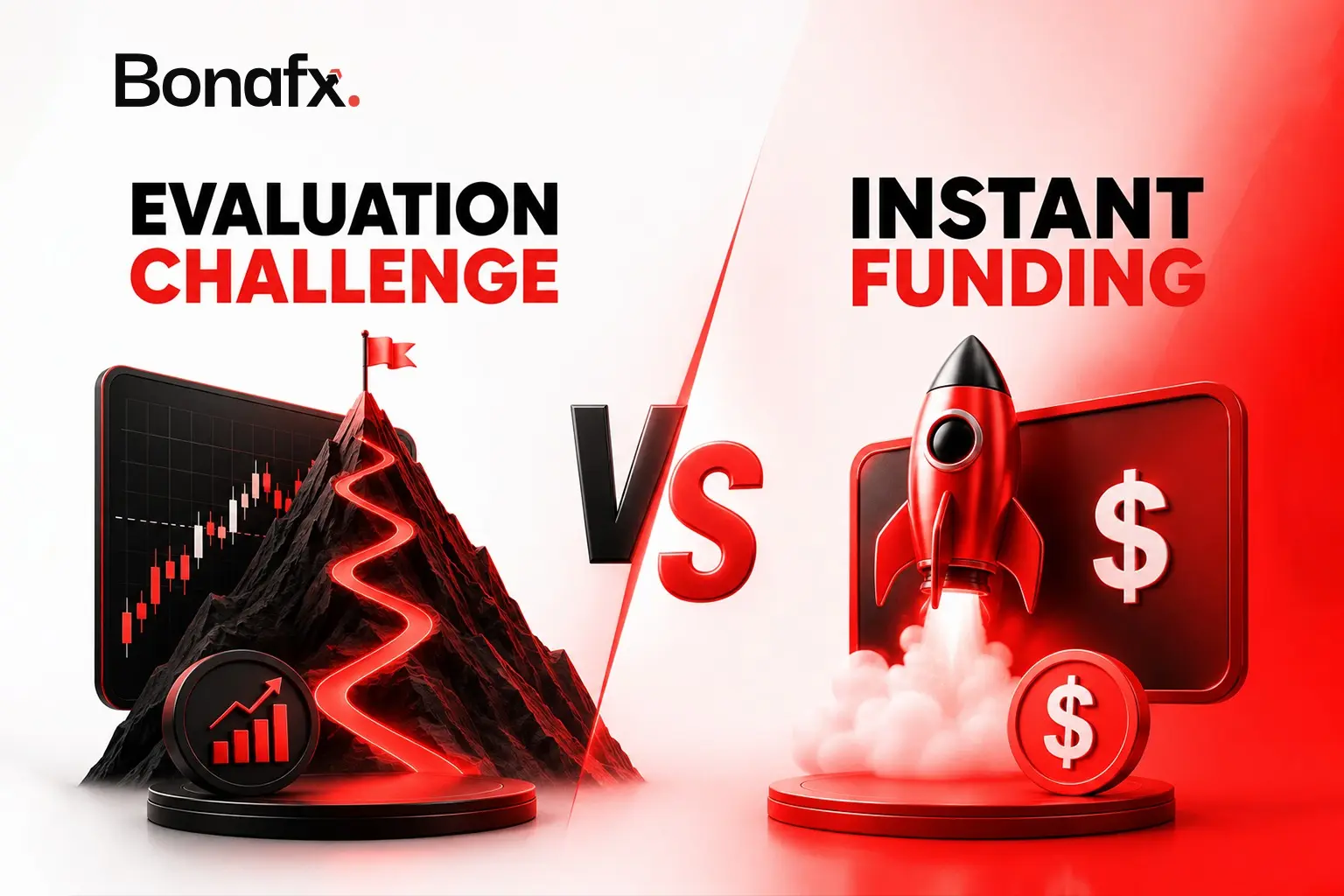
A lot of traders say they want funding fast. What they actually want is a real shot at keeping it. That is why the evaluation challenge versus instant funding debate matters more than the headline promise on a checkout page.
If you already know how prop firms work, you know the pitch on both sides. Evaluation models ask you to prove performance before access to funded status. Instant funding models promise immediate buying power with fewer steps. On paper, instant funding sounds easier. In practice, the better option depends on how you trade, how you handle drawdown, and how much rule friction you are willing to tolerate.
Evaluation challenge versus instant funding: what changes in practice
The core difference is simple. An evaluation challenge is a test. You pay for access to a simulated account, trade under defined risk parameters, and earn funded status by meeting profit targets without breaking rules. Instant funding skips the test phase and gives you access to a funded-style account right away.
That sounds like a clean win for instant funding, but traders know better than to judge a setup by the label alone. The real question is what sits behind the offer. How tight is the drawdown? How realistic is the payout path? How much scaling potential do you actually get? And what happens after one bad day?
An evaluation model usually asks for patience upfront. In return, it often offers a larger upside once you pass, more room to scale, and a clearer structure around performance. Instant funding usually sells speed. In return, it may come with lower effective leverage, stricter loss thresholds, reduced payout potential, or pricing that gets expensive fast.
Why many traders still choose the evaluation route
Serious traders do not just want capital access. They want capital access that matches how they already trade. That is where evaluation programs keep their edge.
A well-built evaluation challenge filters for the one thing that matters most in prop trading – repeatable execution. If your strategy is real, proving it over a controlled test period is not a burden. It is part of the process. It also creates a cleaner relationship between trader and firm. You show discipline first. The firm opens the door wider after that.
For many traders, this structure feels more merit-based. You are not paying a premium for the appearance of speed. You are earning better economics through performance. That can mean stronger profit splits, more credible scaling, and fewer compromises once you get funded.
There is also a psychological advantage. Traders who pass an evaluation usually understand the rules because they had to trade through them. That matters. A funded account is only useful if you can protect it, and traders who have already shown they can stay inside the framework often have a better chance of lasting longer.
Where instant funding makes sense
Instant funding is not a gimmick by default. For the right trader, it can be a practical choice.
If you have a proven strategy, tight risk control, and no interest in hitting a profit target before access, instant funding can feel efficient. Some traders simply perform better without the pressure of a challenge metric hanging over every session. Others want to start withdrawing sooner, even if the initial account economics are less attractive.
It can also appeal to traders who dislike evaluation targets on principle. If your edge is steady but not aggressive, an instant model may fit your pace better than a challenge that expects a certain return before advancement.
But this is where discipline matters. Speed should not distract you from the structure. Some instant accounts are built with narrow drawdown buffers that leave little room for normal market variance. Others cap growth or pay less over time. So yes, instant funding can work, but only if the conditions support your style instead of boxing it in.
The hidden cost is usually in the rules
Most traders compare price first. That is understandable, but it is rarely the best place to start.
The bigger cost in prop trading is bad rule design. A cheaper account with confusing restrictions can cost you more than a higher-priced account with transparent conditions. This is true in both evaluation and instant funding models.
When traders get frustrated with prop firms, it is usually not because they lost a trade. It is because they thought they understood the deal and later found out the rules were working against them. Maybe the drawdown was calculated in a way that punished open profit. Maybe the consistency requirement made one good day a problem. Maybe the payout terms shifted once they became eligible.
That is why the evaluation challenge versus instant funding decision should start with rule clarity, not marketing speed. Look at the daily loss limit, the maximum drawdown, the payout process, the platform conditions, and whether the model gives you room to trade like a professional instead of like someone walking through a trap.
Profit potential is rarely equal
Here is the part many traders miss: faster access does not always mean better upside.
Evaluation models often make more sense for traders who want long-term earning power. If the firm offers a strong profit split, a straightforward path to funded status, and a realistic scaling structure, the delayed start can be worth it. You spend time proving your edge once, then operate under better economics after that.
Instant funding can shorten the path to your first payout, but the long-term math may not be as attractive. Lower payout percentages, smaller relative account utility, or limited growth can reduce the benefit of getting started immediately.
For a trader focused on building a durable income stream, this is not a small detail. A model that looks slower at the beginning may outperform over months of disciplined execution.
Platform and execution still matter
A prop offer is not just a rule sheet. It is also the environment where you execute.
If you are trading forex, indices, or metals with serious intent, platform quality matters. Order handling, spreads, chart stability, and device access all affect how well you can follow your plan. This is especially true during an evaluation, where unnecessary friction can turn a valid setup into a failed attempt.
That is one reason many traders prefer firms that keep the process straightforward and the trading environment professional. BonaFx leans into that with MetaTrader 5, raw spreads, and rules designed to stay readable. For traders tired of gimmicks and gotcha clauses, that kind of simplicity is not a bonus. It is the baseline.
Which model fits which trader?
If you are aggressive, highly consistent, and confident in your process, an evaluation challenge may be the better play. It lets you convert skill into stronger funded terms, especially if you can hit targets without forcing trades.
If you are experienced but prefer a slower equity curve, instant funding may feel more natural, provided the drawdown and payout structure are fair. The key phrase is fair. Not fast. Fair.
Newer traders should be especially careful here. Instant funding can sound safer because it skips the test, but it does not remove the need for discipline. In some cases, it exposes weak risk management faster because there is less margin for error. An evaluation can actually be the healthier structure if it forces better habits before larger opportunity.
The right choice comes down to three questions. Can you trade under a target without changing your behavior? Are the rules built for actual trading or for easy failures? And are you choosing based on long-term payout potential or short-term excitement?
The smarter way to decide
Do not ask which model sounds easier. Ask which model gives your edge the best chance to survive.
For some traders, that will be instant funding. For many others, it will be an evaluation challenge with transparent rules, no arbitrary pressure, and a payout structure worth earning. The best prop model is not the one that promises the fastest start. It is the one that turns disciplined execution into repeatable opportunity.
If your strategy is real, you do not need smoke and mirrors. You need a fair track, clean rules, and enough room to perform. Start there, and the funding path gets a lot clearer.