
A strong trading month means more when you know exactly what you keep. That is the practical question behind how profit splits work: after you produce eligible profits on a funded account, what share is yours, what share stays with the firm, and what conditions affect your withdrawal?
For traders using a prop firm model, a profit split is not a vague promise. It should be a clear percentage, applied to verified performance under the account rules. The better you understand the math and the terms around it, the easier it is to choose a firm, plan risk, and trade without payout surprises.
How profit splits work at a prop firm
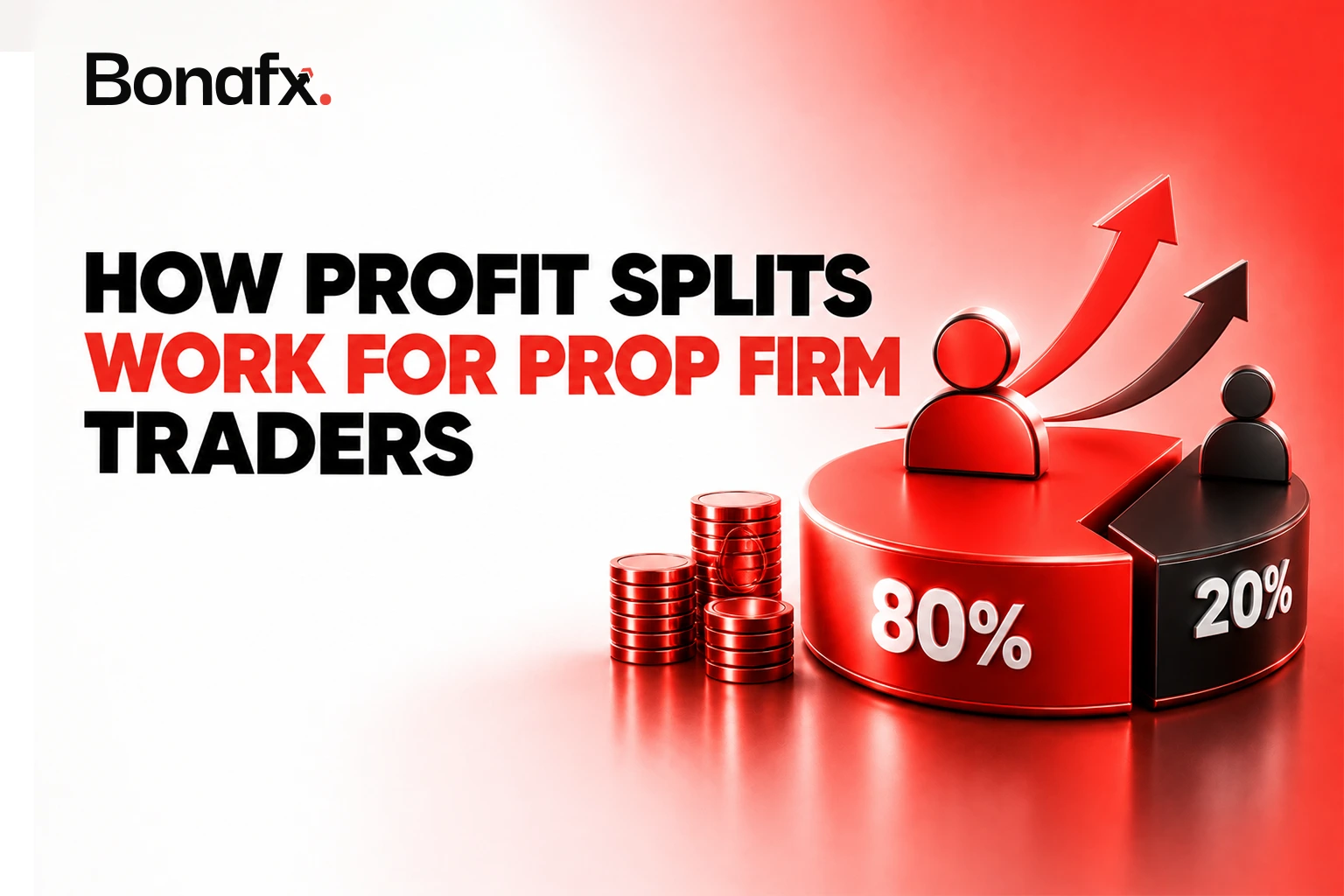
A profit split is the percentage of eligible profits paid to the trader after a payout period. If your agreement offers an 80% split and you generate $5,000 in eligible profit, your trader reward is $4,000. The remaining $1,000 is retained by the firm under the program’s terms.
The percentage is simple. The details behind the word eligible deserve your attention.
Most prop firms operate through an evaluation process. You purchase access to a simulated trading challenge, meet the stated objectives while respecting drawdown and other risk rules, then move into a funded stage when you qualify. At that stage, your trading results are tracked under the program rules, and performance-based rewards are calculated from qualifying simulated profits.
That structure matters because a profit split is not the same as a broker account balance. It is a contractual reward calculation. Your results, payout cycle, minimum payout threshold, account standing, and compliance with program rules all determine what can be requested.
A transparent firm tells you those terms before you start. You should not have to hunt through fine print after a profitable month to learn that a payout has an unexpected condition attached.
The basic profit split formula
The calculation itself is direct:
Eligible profit × trader profit split = your payout
Here is how that looks in practice. A trader on an 80% split produces $2,500 in eligible profit during the payout period. Their reward request would be $2,000. If the same trader produces $10,000, their share is $8,000.
The split does not change your responsibility to manage risk. In fact, it makes disciplined execution more valuable. A trader who protects downside and compounds repeatable gains has a better chance of reaching payout after payout than one who chases a single oversized month.
A high percentage looks great on a landing page, but the real value is what remains after the rules are applied. An 80% split with clear, reasonable conditions can be far more useful than a headline percentage that is hard to access in real trading.
Gross profit, net profit, and eligible profit
Traders often see a winning trade total and assume that number is immediately available for withdrawal. Usually, profit split calculations rely on net eligible profit, not a snapshot of gross winners.
Gross profit is the total gain from profitable positions before losses and trading costs. Net profit reflects the complete result after losing trades, spreads, commissions, swaps where applicable, and any other stated platform costs. Eligible profit is the net result that meets the firm’s payout and account-rule requirements.
For example, imagine you close winning positions totaling $4,200 but take $1,000 in losses. Your net trading profit is $3,200 before any applicable costs. If the program confirms that the activity followed all rules and the amount falls within the current payout period, that net figure is the base used for your split.
This is why execution quality matters. Raw spreads, reliable pricing, and a familiar platform such as MetaTrader 5 can make it easier to evaluate a strategy under conditions that resemble serious trading. But platform quality does not replace risk control. You still need a strategy that survives normal losing streaks without putting the account at risk.
What can affect your payout amount
A profit split should be easy to calculate, but several factors can affect the amount available to request. These are not automatically red flags. They become a problem when they are unclear, excessive, or introduced after the fact.
First is the payout cycle. Some firms process reward requests on set dates, while others allow requests after a defined number of active trading days. Know whether your profit must remain in the account until a scheduled window or whether you can request it sooner.
Second is the minimum payout amount. A minimum can be reasonable because it reduces processing friction, but it should be stated plainly. If your share does not reach the threshold, you may need to continue trading until it does.
Third is account compliance. Drawdown limits, prohibited trading practices, position-size rules, and platform policies can all affect eligibility. The key question is not whether rules exist. Every serious program has rules. The question is whether you can understand them, monitor them, and trade around them without guessing.
Finally, some firms use consistency requirements that limit how much of a payout can come from one strong day. These rules can punish traders who capitalize on a legitimate high-quality setup. If consistency is part of a program, it should be simple, visible, and realistic for your trading style. If it is not, a great split percentage may not mean much.
A higher split is not the only number that matters
An 80% share is meaningful. Over repeated payout periods, keeping more of your eligible gains can create a major difference in your trading income. Still, do not choose a prop firm based on the split alone.
Consider the full payout path: the evaluation fee, the profit target, drawdown structure, time limits, platform costs, payout schedule, and the rules that can disqualify a request. A lower stated split with easy, dependable access may suit some traders better than a higher split locked behind restrictive conditions.
The best setup depends on your approach. A short-term trader may care deeply about spreads, commissions, news rules, and execution. A swing trader may focus on overnight holding terms and weekend exposure. A trader building consistency may value no time limit more than an aggressive target, because pressure to finish fast can push good traders into bad decisions.
BonaFx is built around a cleaner version of that path: clear evaluation expectations, no time limits, professional MetaTrader 5 access, and profit splits of up to 80%. The point is not to make trading easy. Trading requires skill. The point is to make the rules around proving that skill easier to understand.
How to protect more of your profits
Your profit split is only valuable if you stay eligible for it. That starts before your first order, not on payout day.
Trade a size that leaves room for normal volatility. Many payout problems begin when a trader has a profitable run, increases risk too quickly, then gives back gains or violates a drawdown limit trying to recover. A controlled position size keeps a bad session from becoming an account-ending event.
Keep your own records as well. Track closed profit and loss, open exposure, lot size, daily drawdown, and the dates that matter for payout eligibility. Your platform shows essential data, but a simple trading journal gives you a second view of your performance and helps you spot habits that erode results.
Before requesting a payout, review the rules as carefully as you reviewed your setup. Confirm your account status, check whether all positions must be closed, verify the payout window, and make sure your identity and payment details are complete if the firm requires verification. Preparation protects momentum.
Questions to ask before you commit
You do not need a legal degree to understand a fair profit split. You need direct answers. Ask what percentage you receive at each account stage, how eligible profit is calculated, when you can request a payout, and whether there are caps or minimums.
Also ask what happens after a payout. Does the account continue at the same size? Does a withdrawal affect your drawdown buffer? Are there scaling opportunities for traders who show repeatable performance? These answers shape your long-term earning potential more than one impressive percentage on its own.
If a firm cannot explain its payout terms in plain language, treat that as useful information. Your capital partner should make the route from profitable trading to a reward request clear enough to understand before you pay for an evaluation.
Profit splits reward performance, but they also reward preparation. Choose terms you can follow, trade a plan you can repeat, and let each disciplined payout prove that your edge is built for more than one good week.