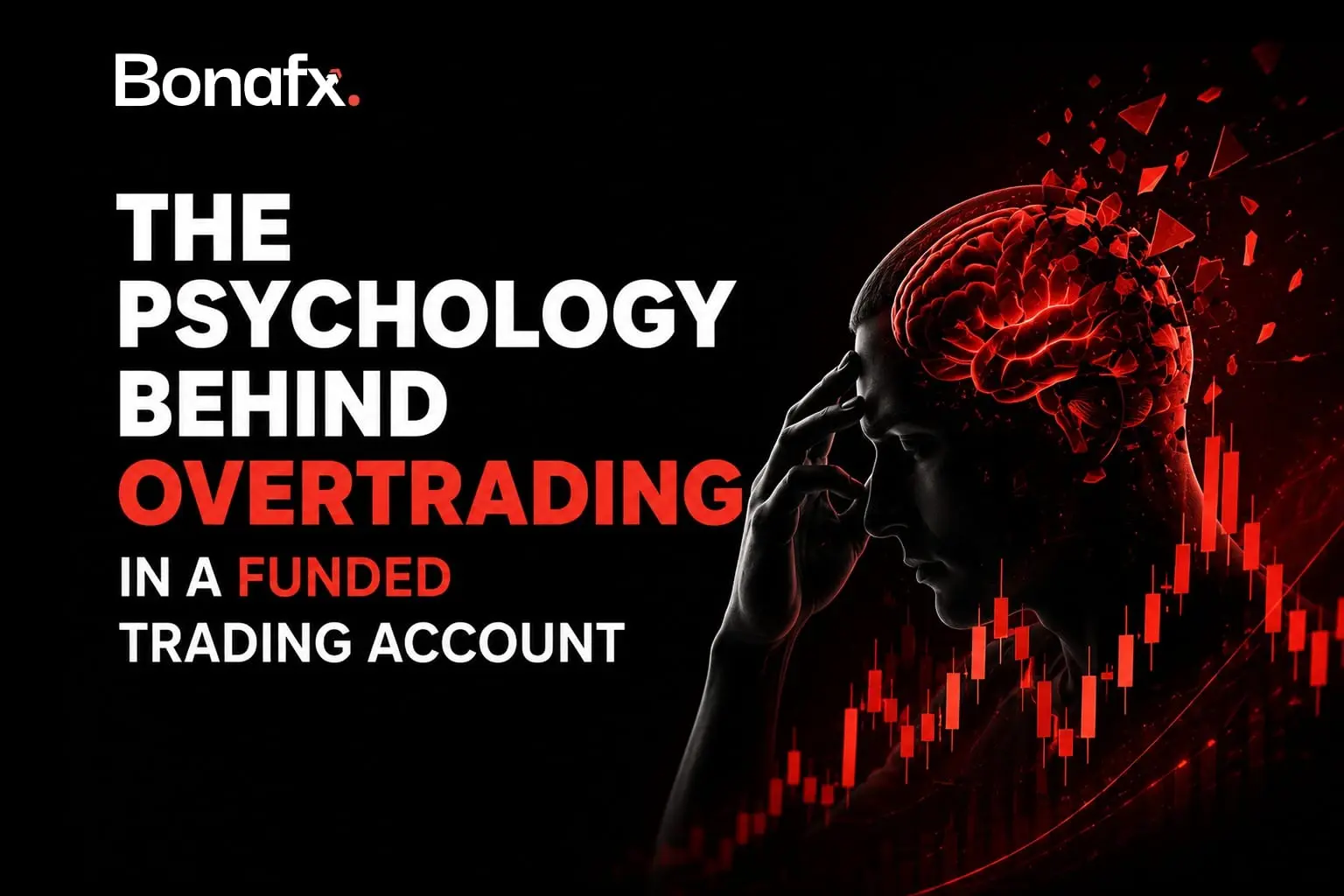
Most traders who lose a funded trading account never had a strategy problem. Their strategy and entries were fine, but emotions affected their discipline. Once the funded stage pressure started, unnecessary trades slowly ruined weeks of good trading.
Overtrading is the most common silent killer in prop trading, and it rarely looks dramatic from outside. It starts with one extra trade after a bad session. Then another after a strong day. Then it becomes a habit that no indicator can fix. Understanding why it happens in the first place. To make sure it does not happen to you.
Why Overtrading Happens More in a Funded Trading Account
Trading in these types of accounts is psychologically different from trading with your own money. When personal savings are at stake, most traders feel a natural caution that slows them down. When traders start using a prop firm’s money with strict loss rules, they begin feeling a different kind of pressure—the pressure to perform, to protect the account, and to prove they deserve the opportunity.
That pressure changes how decisions are made. Traders begin monitoring every PIP (Percentage in Point). They check the P&L between setups. They start questioning whether their next trade needs to happen right now, before the session ends, before the profit slips away. That mindset is where overtrading begins. It is not laziness or recklessness. Traders think they are being productive, but it is actually anxiety.
Many traders are working towards a free funded trading account at BonaFx. They describe the evaluation phase as the hardest part—not because the rules are complicated, but because the emotional experience of trading with consequences intensifies everything.
The Real Psychological Triggers Behind Overtrading
Fear is the most obvious trigger. After a losing trade, many traders feel an urgent need to recover the loss before the session ends. That urgency bypasses the checklist, ignores the setup quality, and pulls them into trades. They would never take it on a calm day; drawdown limits make this worse because every loss now carries a second layer of meaning, it is not just a loss; it is a loss that pushes the account closer to a breach.
Revenge trading is the direct result of that fear. It looks like aggression, but it is real panic. The lot size increases, the patience disappears, and entries happen based on frustration rather than structure. One emotional trade can erase the discipline built over two or three clean trading weeks.
What most blogs miss, however, is the opposite trigger: overconfidence after a winning trade. Traders rarely talk about this, but a strong, profitable session produces dopamine. That dopamine creates what experienced traders call “winner’s tilt” — a state where the brain feels invincible and starts treating the next trade as an obvious winner before it has even formed. This is where profitable days often turn into breakeven or losing ones.
There is also a quieter trigger that gets almost no attention: boredom. Watching charts without finding a good setup can make traders feel unproductive. When traders feel like they have to stay busy and useful, they end up making trades that don’t really make sense. This happens a lot when the market is quiet, and nothing clear is forming.
Lesser-Known Reasons Traders Overtrade in These Accounts
A free-funded trading account introduces a unique psychological trap because there is no upfront cost, so many traders unconsciously treat the challenge as disposable. The logic goes that if it fails, they can just try again. That reasoning feels sensible, but it builds exactly the bad habits. If you trade carelessly during a free trial, those bad habits won’t just stay there—they’ll follow you into the real funded account.
“One more trade”—this trap is common in challenge accounts. Traders get close to the profit target and start forcing setups to finish faster. They stop thinking about each trade as a real choice and start seeing it as another step toward a random goal. That shift turns a structured approach into a gambling session.
Social media makes this worse. Discord channels, Telegram groups, and YouTube comment sections are filled with payout screenshots. Seeing other traders withdraw large amounts creates comparison pressure—a feeling that you should be at the same stage by now, that your progress is too slow, and that more trades equal more speed. None of this is true, but the emotional logic feels convincing in that moment.
Firms like BonaFx are designed around a long-term trader mindset, not with a challenge-completion mentality. Understanding how drawdown rules actually work before you begin changes your entire relationship with risk — and makes it much easier to stay patient when the market is not offering clean opportunities.
Warning Signs You Are Overtrading Without Realising It
The problem with overtrading is that it rarely announces itself. Most traders only recognize it after reviewing a bad week and wondering how it happened. The warning signs are subtle while they are developing.
You are probably overtrading if you are taking trades outside your defined setup criteria, trading during times you already know are bad, jumping into a new trade just minutes after ending the last one, or skipping your trading journal because journaling slows down things. If you feel anxious in a flat market—not just bored, but really uneasy about not being in a trade—that feeling is something you should notice and take seriously.
How Overtrading Slowly Destroys a Funded Trading Account
Overtrading rarely blows an account in a single session—it builds up slowly over time. Spread costs and commissions accumulate across dozens of low-quality trades. Risk starts increasing as traders try to recover small losses. They move their safety limits (“stop losses”) to avoid being forced out. And their confidence slowly falls apart.
The most damaging part is what happens to a trader’s psychology after a bad overtrading stretch. They stop trusting their own setups. They start doubting good trades and hesitate on entries they would normally take without thinking. The strategy did not fail them — the emotional spiral made the strategy impossible to execute cleanly.
This is the real cost of overtrading in a simulated funded trading account. It does not just cost a challenge fee. It costs the trader’s confidence in themselves, which is much harder to rebuild.
Practical Ways to Stop Overtrading in a Funded Trading Account
The solution is structure, not willpower. Willpower doesn’t last, but structure works on its own.
Setting a maximum trades-per-day rule is one of the most effective tools available. Professional traders rarely take more than two or three trades in a session. It makes traders focus on good setups instead of taking random trades just to stay active.
Taking a short break after every trade—even a winning one—helps your mind reset before the next decision. Stepping away from the charts for about 15 minutes is usually enough to stop emotional or rushed thinking.
The most overlooked shift is moving focus from profit targets to process targets. Instead of focusing on how close you are to a payout, focus on how well you are following your rules consistently. Traders who focus on following their rules instead of just profits usually reach payouts faster because steady consistency builds up over time.
Start a separate notebook just for your thoughts and feelings, apart from your trade journal. That’s a good idea and worth doing right now. Track how you felt before a trade, during it, and after. Patterns reveal themselves quickly. Revenge trades tend to happen at specific times. Winner’s tilt tends to follow specific session types. Once the pattern is visible, it becomes manageable.
BonaFx builds its evaluation structure around traders who think like risk managers first. Understanding how to choose a prop firm that actually pays helps you see why the process matters as much as the profit target.
The Biggest Truth Most Traders Learn Too Late
The majority of traders who lose funded accounts spend their recovery time searching for better indicators, new strategies, or different instruments. Very few of them spend that time examining their emotional patterns.
Most funded traders who consistently earn payouts are not trading secret systems. They are using simple trading systems but following them very consistently. They take fewer trades than most beginners expect. They skip trading sessions that don’t have clean setups without feeling like they are missing out. They understand that a funded trading account rewards discipline more than intelligence, and patience more than speed.
The real competition in prop trading is not against the market. It is against your own impulses on a slow Tuesday afternoon when nothing is happening, and the urge to do something is strong.
Conclusion
Overtrading is not a strategy failure. It is a psychological one—and it can be fixed. Fear, overconfidence, boredom, social comparison, and the pressure of trading someone else’s capital all create conditions where unnecessary trades feel justified in the moment and regrettable in the review.
Traders who understand these triggers before they experience them are far better prepared to manage them when they arrive. Whether you are working through an evaluation or already funded, the habits that protect a funded trading account are the same: fewer trades, clearer rules, honest journaling, and a consistent focus on process over payout speed.
If you are ready to start building those habits with real structure behind them, BonaFx offers a funded trading account program designed for traders who want to trade right, not just trade often.