
Most traders do not fail a challenge because their strategy is broken. They fail because they traded one set of assumptions while the account was governed by another. If you want to know how to read challenge rules the right way, stop treating the rule page like legal filler and start reading it like a risk framework that controls every decision you make.
A challenge account is not just a chart, a balance, and a target. It is a contract between your strategy and the firm’s risk limits. If you miss that, you can be profitable on paper and still lose the account. Serious traders know better. They read the rules before the first order, then they shape execution around them.
How to read challenge rules without missing the real risk
The mistake is focusing on the headline offer and ignoring the operating limits. Traders see profit split, account size, and platform access. Then they skim past drawdown mechanics, position restrictions, payout conditions, and behavior rules that actually determine whether the account survives.
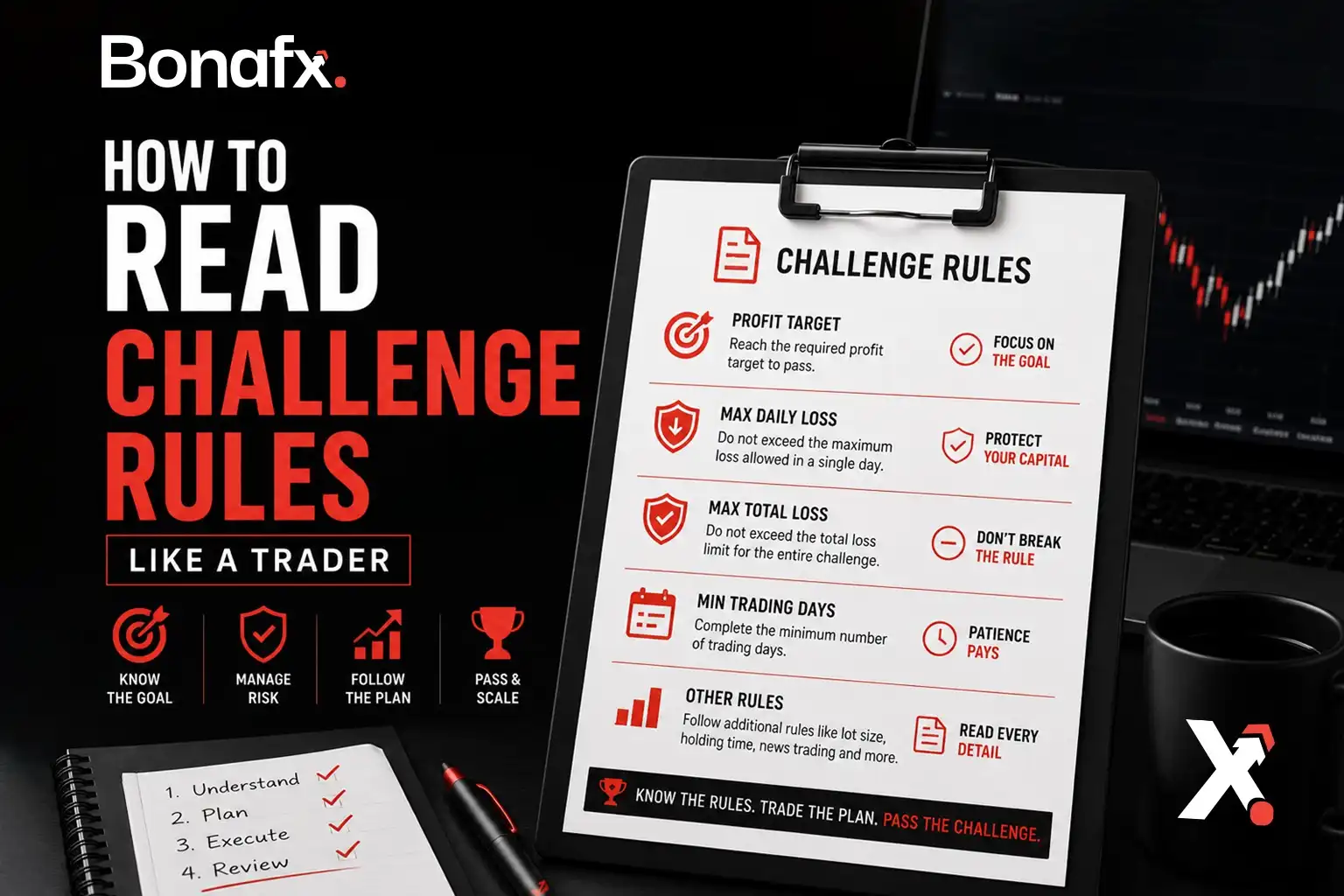
The clean way to read any challenge is to separate rules into four buckets: loss limits, trading permissions, performance targets, and payout conditions. Those four areas tell you almost everything that matters.
Loss limits come first because they override everything else. A strong setup means nothing if one bad execution breaches the account. Trading permissions come next because they define what kind of strategy is even allowed. Performance targets matter after that because they shape your pace and sizing. Payout conditions matter last, but they still matter, because a funded account is only valuable if the path to withdrawal is clear.
Start with drawdown, not the profit target
Most traders read the target first because it feels like the finish line. That is backward. The real question is how much room the account gives you before you are out.
Look for the maximum total drawdown and the maximum daily drawdown. Then read how each one is calculated. This is where challenge rules often stop being simple.
A total drawdown can be static or trailing. A static drawdown is easier to manage because the line does not move as your balance rises. A trailing drawdown can tighten the account behind you as you make profits, which changes how aggressively you can scale. If the rule set uses trailing logic, you need to know whether it trails equity, balance, or a high-water mark. Those are not minor details. They change trade management in a big way.
Daily drawdown also needs a close reading. Some firms calculate it from the day’s starting balance. Others include floating loss. Others reset at a specific server time that may not match your local session. If you trade around New York open, hold positions into rollover, or scale in during volatility, the reset time and equity method matter.
If one sentence about drawdown feels vague, assume it is not vague in practice. Get clarity before you trade.
What a trader should ask when reading drawdown rules
Ask yourself three direct questions. What exactly is the loss limit? When exactly is it measured? Does unrealized P and L count?
Those three answers tell you whether your current risk model fits the account. If they do not, the answer is not to hope for the best. The answer is to adjust position size, session timing, or holding period.
Read the restrictions like they apply to your exact strategy
A rule can look harmless until it collides with the way you actually trade. That is why broad reading is not enough. You need strategy-level reading.
If you hold through news, check whether news trading is allowed. If you use expert advisors, read the automation policy carefully. If you copy trades between accounts, check whether copy trading is permitted and under what conditions. If you scalp, check for minimum hold times, maximum lot concentration, or rules against latency arbitrage and quote abuse.
This is where traders get caught. They read a restriction and assume it only targets obvious abuse. Then their normal execution falls into the same bucket because the language is broad or the detection system is automated.
The right approach is simple. Read every restriction and ask, Does my strategy touch this directly, indirectly, or under stress? Under stress matters because your behavior changes in drawdown. A trader who usually exits before red folder news may hold through it when trying to recover. A trader who normally keeps size stable may double risk after two losses. Rules do not become flexible because emotions get louder.
How to read challenge rules for payout reality
A funded account is only as strong as its payout terms. This part should be easy to understand. If it takes five readings to figure out when and how you get paid, that is already a signal.
Check the minimum trading days, profit split, payout schedule, and any consistency or behavior filters tied to withdrawals. Some firms advertise a strong split, then attach conditions that make withdrawals harder than they appear. Others keep it straightforward. That difference matters more than marketing language.
Read for anything that can delay or deny a payout even after a profitable period. That includes vague phrases around suspicious activity, prohibited strategies, abnormal risk concentration, or discretionary review. Some oversight is normal. What matters is whether the rules are specific enough for a disciplined trader to follow with confidence.
This is one reason firms that keep their model clear stand out. Traders do not need more fine print. They need a straight line from compliant execution to payout.
Check the account mechanics traders ignore
A surprising number of challenge failures come from mechanics, not market calls. The trader was right on direction and still lost the account because they misunderstood the operating environment.
Read the platform details. Know the server time. Check whether commissions and swaps affect drawdown calculations. Confirm instrument availability, leverage by asset class, and contract specifications. If you trade indices, gold, or crypto alongside forex, those details can affect both risk and holding cost.
Also check whether there are time limits, inactivity rules, or minimum active trading requirements. A no-time-limit model gives you more control. A compressed timeline can force bad trades and distort otherwise solid performance. That trade-off should be clear before you buy the challenge, not after a slow week of disciplined patience.
Treat vague language as a decision point
Not every rulebook is clean. Some are written clearly. Others leave too much open to interpretation.
When you see phrases like excessive risk, gambling behavior, unrealistic trading, or suspicious activity, do not ignore them. Those phrases may have reasonable intent, but they need context. If the firm defines them with examples, thresholds, or clear enforcement logic, good. If not, you are being asked to operate inside uncertainty.
For serious traders, uncertainty in rules is not a small issue. You already manage uncertainty in the market. You should not have to manage it in the evaluation framework too.
That does not mean every flexible clause is bad. It means transparency matters. The cleaner the explanation, the easier it is to trade with confidence and scale responsibly.
Build a personal rule checklist before your first trade
Once you finish reading, reduce the rules into your own execution checklist. This should not be a copy of the website. It should be a trader-ready version written in plain language.
Write down your max daily loss in dollar terms, your max total loss, whether floating P and L counts, the server reset time, restricted trading behaviors, allowed holding periods, and payout prerequisites. Then map those rules to your actual plan.
If your strategy risks 1% per trade but the account structure makes two normal losses uncomfortably close to the daily limit, your real issue is not discipline. It is mismatch. Fix the mismatch before you place the trade.
This is where experienced traders separate themselves. They do not just ask, Can I pass this challenge? They ask, Can I trade my edge cleanly within these rules for long enough to get paid?
The best challenge rules feel clear before they feel generous
Generous terms get attention. Clear terms keep traders in the game.
A challenge with simple drawdown logic, transparent payout conditions, and realistic trading freedom gives you something better than hype. It gives you control. That is what serious traders want. Not gimmicks. Not traps. Just a fair framework where execution decides the outcome.
If you are comparing firms, this is the filter that matters most. A flashy offer can pull you in. Clean rules tell you whether the opportunity is real. BonaFx is built around that idea – less friction, fewer hidden catches, and a structure traders can actually work with.
Read every challenge rule like your account depends on it, because it does. The traders who last are not just good at entries and exits. They are good at spotting the difference between a real opportunity and a rulebook that was designed to beat them first.